

OneNote by Microsoft could be considered an effective tool to manage projects for teams that work with Microsoft 365. As stated by Microsoft Support, OneNote provides support for real-time co-authoring, where all team members can collaborate in one single notebook. The key strategy is to create a special notebook, where each section would correspond to different stages of a project – namely, Planning, Execution, Review, and Resources – and use To-Do tags, which are included in OneNote. Tags are quick to find via Tag Summary, and there is integration with Microsoft To Do and Outlook Tasks. With the help of shared notebooks in Microsoft 365, everyone involved in a project gets access to meeting notes, decision logs, and other references without having to change applications. With OneNote integration with Microsoft Teams, notebooks can be pinned to a Teams channel tab. For teams that manage not only projects but contracts as well, Dock 365 adds contract and vendor management capabilities to Microsoft 365 native SharePoint.

The first step for any project with OneNote is to make sure your team is familiar with the software. It’s a promising idea to get everyone up to speed before taking on an important project. Moving forward with the idea that your team has access to OneNote and has the fundamentals down, let’s dive into how this software that comes with your Office 365 subscription can boost your productivity with project management.
Why Is Microsoft OneNote Useful for Project Management?
OneNote can be said to find a good balance between Microsoft Planner and Project, being more open-ended than the former while more structured than a file cabinet of informal notes. Its notebook/section/page structure reflects how projects are generally organized, through phase, topic, or work stream, and because of its tight integration with Outlook, Teams, and Planner, it serves as an intermediary layer that connects everything in the Microsoft 365 ecosystem. As per Microsoft Support, OneNote is available on Windows, Mac, iOS, and Android devices as well as via browsers, so all project participants will have the ability to add and retrieve content from any device. In addition, if you already use the entire Microsoft 365 suite within your organization, then incorporating OneNote for documentation of your projects will not require any additional licenses, vendor, or data transfer as your notebooks will reside right within the Microsoft 365 environment.
Step 1: How Do You Create a Project Notebook in OneNote?
The first step in structuring project management with the help of OneNote is creating a separate notebook for each project, which is crucial for effective work organization and management. The creation of a separate notebook enables one to distinguish project materials from personal or general team information, provides easy sharing options, and gives the project its own place to stay relevant even after team member changes. When working within Microsoft 365, the new notebook should be created using either OneNote for Windows or the web application at onenote.com; these applications will automatically save the notebook in OneDrive or SharePoint, thus making it available for all the people invited by you. Notebooks saved to SharePoint document libraries are accessible straight from a SharePoint website, which is quite convenient when the team of the project works with SharePoint Team Site as a central collaboration site.
Step 2: How Should You Organize OneNote Sections for Project Management?
Sections in OneNote are comparable to the labels used in binders – they help you organize related pages and find what you need in seconds. In the case of project management, there is a well-established system of sections that corresponds to different phases of the project, such as: Planning Section: scope documentation, list of stakeholders, initial decisions; Execution Section: weekly status reports, issue log, and progress notes; Review Section: retrospectives, lessons learned, sign-offs; Resources Section: references, templates, links to other documents. Other sections can be added depending on the number of work streams and the complexity of your project. As stated in the Microsoft OneNote developer reference, sections can be sorted, color-coded, and grouped into section groups if your notebook has numerous work streams. Sections color coding by phases will immediately tell you the status of your project, e.g., blue color for planning phase, green for active execution phase, and grey for a completed phase.
Step 3: How Do You Track Tasks and Action Items in OneNote?
Tagging in OneNote is a built-in feature that serves as the basis for task management within the notebook. With the To-Do tag (shortcut keys Ctrl+1 on Windows), any text line receives a checkbox, allowing meeting action items, follow-up information, and deliverable deadlines to become actionable tasks right where they occur. Find Tags pane in the Home ribbon shows all tags from throughout the notebook, providing managers with a summarized task list. Tags can be searched and filtered by section, by date, and even by type of tag, allowing finding the necessary action items from a particular stage or a specific meeting. In cases when there is a need for more organized task management, OneNote allows for integration with Microsoft To Do – the tag-based tasks can be presented in To Do as assignments with due dates. As stated by Microsoft Support, there are over 20 tag types included in OneNote aside from To-Do, such as Important, Question, and Remember for Later.
Step 4: How Do You Capture Meeting Notes Effectively in OneNote?
Another highly valuable use case of OneNote in projects is creating structured meeting notes. For each meeting, there must be a separate page within the appropriate section of the corresponding project phase. The page is named using the format "date + topic". The built-in function of OneNote "Insert > Meeting Details" retrieves all information about the event in question from the corresponding entry in the Outlook calendar – the name of the event, its date and time, the list of attendees, and the comments made in the meeting invitation. During the meeting itself, agenda points, decision points, and action items are recorded in real time, and "To-Do" tags are put on the action items. Afterwards, the page can be shared by using the direct link to it or emailed from within OneNote; it can also be exported as a PDF document and sent to the attendees without access to the notebook. According to Microsoft Support, OneNote allows one to record audio and video on its pages.
Step 5: How Do You Share a OneNote Notebook with Your Project Team?
It is easy to share a OneNote notebook located in Microsoft 365; in OneNote, go to Share and send invitations to others using either their names or e-mail addresses. These people will get a URL, which will allow them to view or edit this notebook right away using their web browsers or OneNote application without downloading anything extra. According to Microsoft Support, modifications made by authors are synced right away with the shared notebook and are displayed by OneNote using a highlight color with the author's name while working on this notebook. In the case when project teams have external participants such as clients or suppliers, the possibility exists to share the notebook with guest users having their own account in this Microsoft 365 tenant. All access sharing is regulated using the same access control systems for Microsoft 365 used for SharePoint, Teams, and Outlook.
Step 6: How Do You Integrate OneNote with Microsoft Teams and Planner?
Microsoft Teams integration in OneNote is arguably one of the most practical features of the software when it comes to managing projects. Every OneNote notebook can be added as a tab in a Teams channel, making sure that the project notes are right next to chat logs, files, and meetings in the same channel without needing to leave the channel and navigate to another app. When a Microsoft Teams channel is created, a OneNote notebook is provisioned automatically, being attached to the SharePoint site where the Microsoft Teams channel resides. As per Microsoft Support, OneNote pages may be directly added to the conversation thread in Teams as a link, thus allowing focused discussion of those notes without interfering with general discussions on the channel. When it comes to task management outside OneNote tags, Microsoft Planner can be used to create a task board, which can then be pinned to the same Teams channel right next to the OneNote tab - providing a side-by-side view of project notes and tasks. In case teams have projects involving contract management, Dock 365 extends the capabilities of Microsoft 365 platform with a dedicated contract management feature set.
Customize Your Visual Cues
Now that you have the basics down, it’s time to customize many visual aspects to make the program looks aesthetically pleasing for each user. You can change things such as the font, page background as well as the tab colors to organize projects with visual cues.
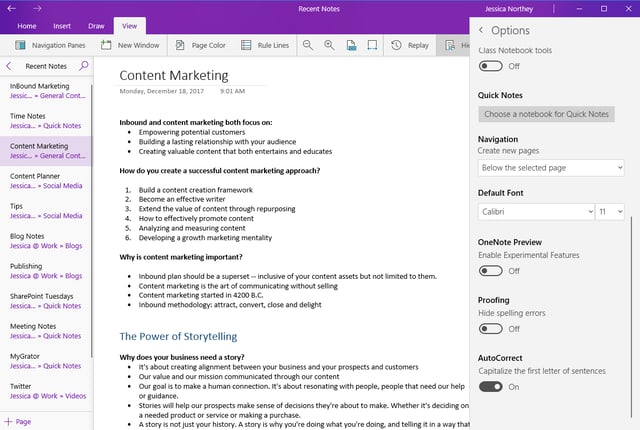
Go to Options and look for “Default Font” to choose your favorite one.
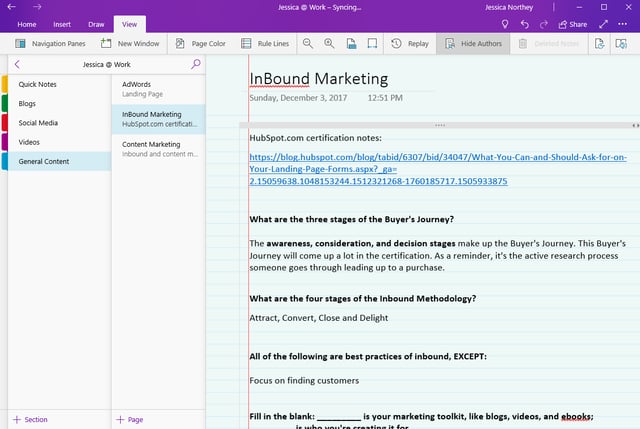
Organize projects by the page color under the View tab, you can also make it look like notebook paper.
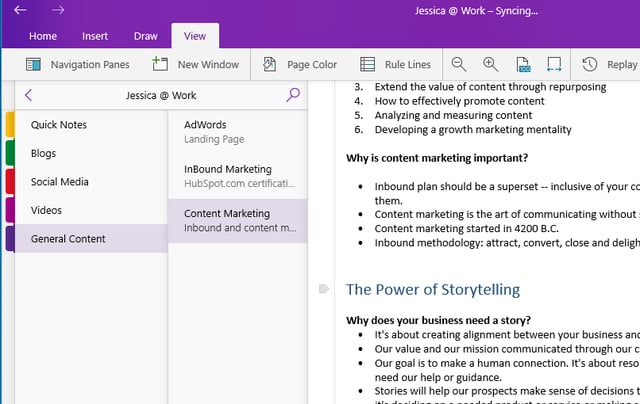
Change the default tab colors from yellow, green and red to a distinct color by hovering over the tab heading and right click with your mouse to find the color options.
Based on the project you’re managing, easy customizations as mentioned above can be a game changer for saving time with visual organization. For example, you can have one project tab color as yellow and all the page backgrounds are yellow to keep notes organized faster.
Suggested Blog: Go Paperless with OneNote and SharePoint Online
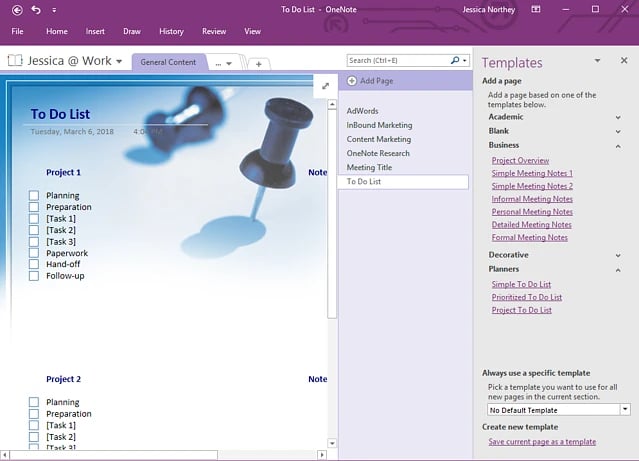
The desktop version has template options to use per section or set your default.
Insert Options for More Organization
Within OneNote, click the Insert tab to find an array of options to organize your notes. This is an area where you can create a table, insert a file or photos related to topic, link to a website link, record audio, include stickers and meeting details as well as the Researcher tab for online sources.
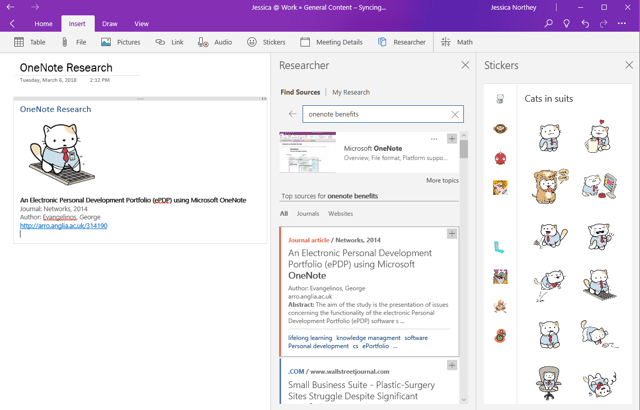
Insert a sticker for fun as well as searching online within OneNote to keep track of sources.
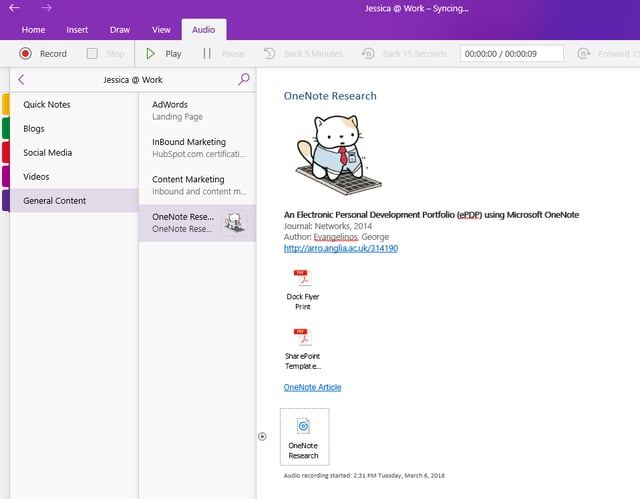
Insert PDF files, link text to a website and record audio notes all in one section.
Create an Organization Strategy
With all the options of notebooks, sections, sub-categories and more, the options for organizing for project management has plenty of options. Now it’s time to determine the organization strategy to stay on top of your numerous tasks and deadlines. Here are some tips to help you get started.
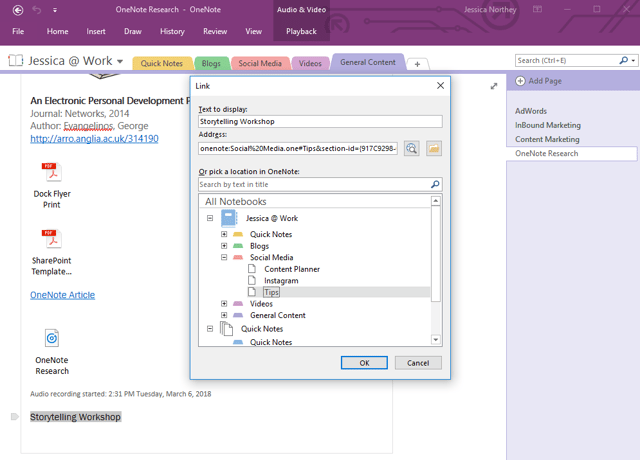
Links
Desktop version has additional options for linking text to a different tab within OneNote or create a new page in the same section. You can also use this panel to link to a webpage.
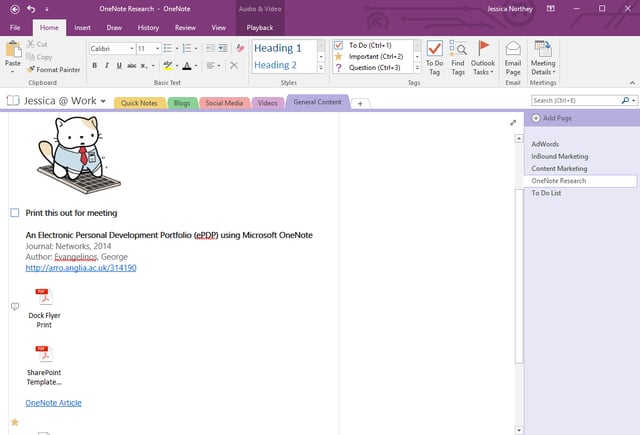
Tags
With the Desktop version, click the Home tab and see the Tags section to insert tags for to do lists, remember later for blog, important tasks and much more. See the small icons to the left of the text. You can also customize tags by making your own “New Tag”. Click the option “Find Tags” to see a summary of the tags you’ve created.
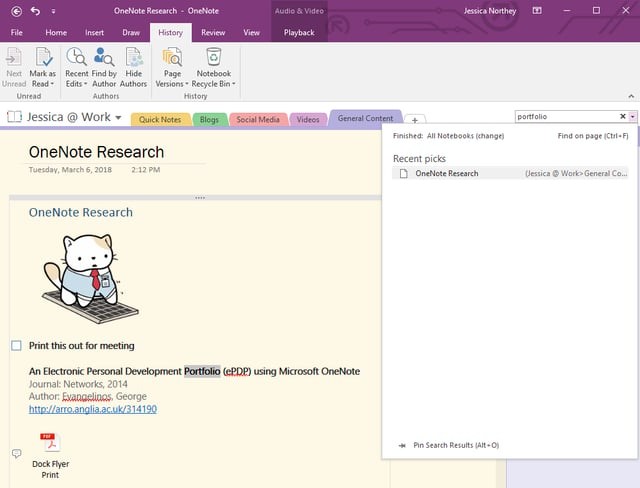
Search
When push comes to shove and you need to quickly find something, use the search feature to find what you need.
Learn more about how to use SharePoint intranet and Office 365 for your Project Management Portal.
Additional Options
Microsoft OneNote online and desktop versions gives the flexibility to work at your desk or while you’re on the move from a mobile device. Learn more from Microsoft videos in a six-part series here:
Suggested blog: 5 Ways for Project Management with a SharePoint Portal

Book a Live demo
Schedule a live demo of Dock 365's Contract Management Software now.